

 ITA
ITA  ENG
ENG SPAN
SPAN FR
FR NL
NL GER
GER FI
FI

 ENG
ENG  ITA
ITA Digital twin: what it is, what it is used for and how it integrates with BIM
Construction digitalization: the new frontier of intelligent management
Digitalization in the construction sector is transforming how buildings are designed, built, and managed. In this context, the digital twin emerges as a key tool for intelligent asset management, offering new opportunities for control, efficiency, and sustainability. Understanding its role and its integration with BIM is essential for professionals in construction and property management.
What is a digital twin?
A digital twin is a dynamic virtual replica of a physical asset, such as a building or system. Unlike a simple digital model, the digital twin continuously updates its data through integration with sensors, IoT devices, and monitoring systems. This enables real-time simulation, analysis, and optimization of the asset’s actual behavior. The concept originates from manufacturing but is increasingly applied in construction and real estate management.
What is a digital twin used for: main applications
The digital twin provides numerous practical applications that enhance building management and maintenance. Key functions include:
- Space management: optimization of space usage and resources.
- Real-time monitoring of critical systems and components.
- IoT data reliability: collection and analysis of data from connected sensors and devices.
- Remote control of systems and processes, even from a distance.
- Predictive simulations to assess future scenarios and prevent failures.
- Predictive maintenance: early detection of anomalies and proactive intervention planning.
- Decision support based on reliable and up-to-date data.
These applications help reduce operating costs, improve safety, and enhance building sustainability.
Difference between BIM and digital twin
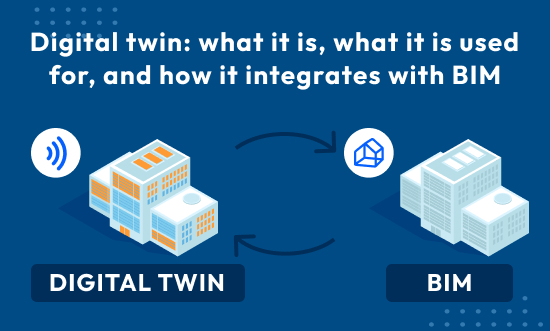
BIM (Building Information Modeling) represents a static digital model of a building, mainly used during design and construction phases. The digital twin, on the other hand, is a dynamic, as-operated model that continuously updates throughout the asset’s lifecycle. While BIM describes the “as-built” state, the digital twin reflects the real and current condition by integrating real-time data. This enables proactive and intelligent building management.
How the digital twin integrates with BIM
The integration of the digital twin with BIM is a fundamental evolution in building management. The process occurs through:
- Starting from the BIM model: the digital twin is based on a detailed BIM model that provides the building’s geometric and informational structure.
- Enrichment with real data: through IoT sensors, BMS (Building Management Systems), and monitoring devices, the model is updated with real-time data on consumption, system status, and environmental conditions.
- Centralized information: all data is collected into a single platform, enhancing team collaboration and information sharing among stakeholders.
- Interoperability: integrating BIM with the digital twin connects different systems and formats, ensuring smooth and continuous management throughout the building lifecycle.
This synergy enables process optimization, improved predictive maintenance, and informed decision-making based on reliable, up-to-date data.
Concrete benefits for building management and maintenance
Adopting a BIM-integrated digital twin offers many tangible benefits:
- Reduced operating costs through targeted actions and predictive maintenance.
- Operational efficiency enabled by automated processes and continuous monitoring.
- Faster response times in case of failures or anomalies thanks to real-time alerts.
- Environmental sustainability through optimized energy consumption and reduced waste.
- Improved planning of maintenance activities and system upgrades.
- Increased real estate value through transparent and well-documented asset management.
Challenges and opportunities in adopting the digital twin
Implementing a digital twin involves some challenges, such as initial investment, the need for digital skills, and managing interoperability between different systems. However, the opportunities for innovation and growth are significant: greater efficiency, new business models, and more sustainable building management.
UTwin: the all-in-one solution for digital twin and CMMS
UTwin is a platform that integrates digital twin and CMMS (Computerized Maintenance Management System) into a single solution. Key advantages include:
- Plug-and-play integration with existing systems and support for multiple formats (BIM, CAD, PDF).
- User-friendly interface for intuitive and accessible management.
- Centralized and historical data for complete and traceable control.
- Modularity and fast onboarding to adapt to any business need.
- Dedicated APIs for customization and interoperability with other software.
UTwin is a concrete example of how digital twin technology can be effectively and scalably applied to building management.
Future perspectives of the digital twin in construction
The digital twin is set to become a standard in the management of smart buildings and smart cities. The evolution of digital technologies will lead to deeper integration of data, automation, and sustainability, opening new paths for innovation and value creation in real estate assets.


Informative Material