

 ITA
ITA  ENG
ENG SPAN
SPAN FR
FR NL
NL GER
GER FI
FI

 ENG
ENG  ITA
ITA Energy Management in Production Plants: Efficiency, Competitiveness, and Sustainability
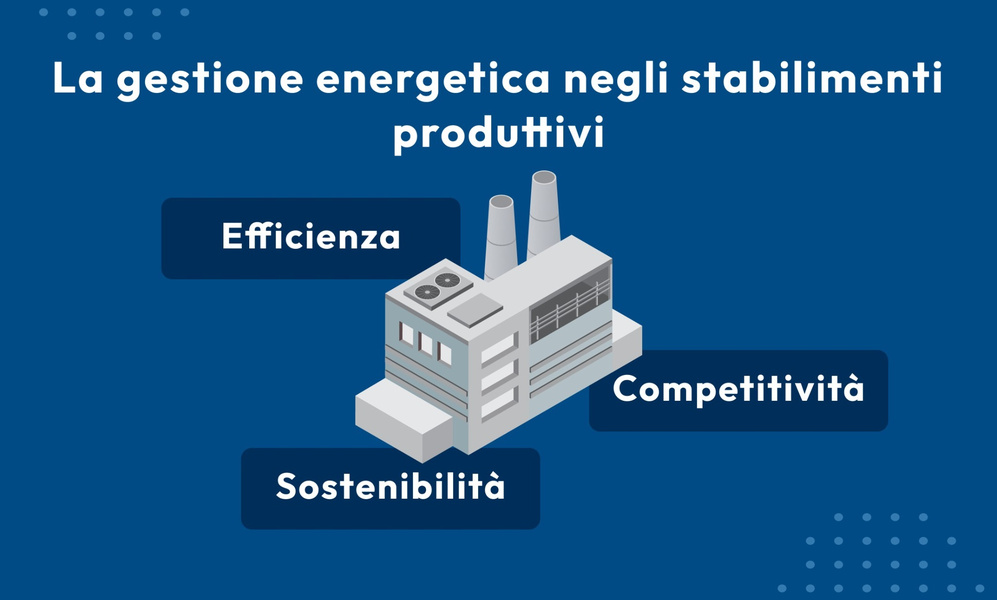
In the contemporary industrial landscape, energy management is no longer a simple cost item to be passively monitored, but a fundamental strategic lever to guarantee corporate competitiveness. Production plants are by definition resource-demanding and energy-intensive structures, where electricity, natural gas, and thermal energy fuel the core processes of the business. Optimizing these flows means not only reducing environmental impact, but also increasing profit margins and protecting the company from the volatility of energy markets.
The Pillars of Industrial Energy Management
A modern and effective approach to energy management within a factory is structured around three main directions, which transform the way the resource is purchased, distributed, and consumed.
- The Energy Audit: Represents the essential starting point. It consists of an in-depth analysis of the facility to map historical consumption, identify waste, and define the plant's energy load profiles. In Italy and Europe, for many large and energy-intensive companies, this audit is a periodic legal obligation.
- ISO 50001 Certification: The adoption of an Energy Management System (EnMS) certified according to the international standard ISO 50001 makes it possible to structure company processes with a view to continuous improvement (PDCA cycle: Plan, Do, Check, Act), involving all personnel, from management to line operators.
- Real-Time Monitoring: You cannot manage what you do not measure. Installing fiscal meters and sub-meters positioned on individual production lines allows the collection of granular data, isolating the consumption of auxiliary services from that of process machinery.
High-Impact Technical Interventions
Once consumption is mapped, energy management translates into concrete efficiency actions. Interventions are usually split between the optimization of general services and changes to production processes.
- Efficiency of Auxiliary Services: Often the greatest waste hides within the systems supporting production.
- Compressed air systems: Leaks in compressed air networks can waste up to 30% of the energy consumed by compressors. Predictive maintenance and line sealing offer immediate economic returns.
- Electric motors and inverters: Replacing old motors with high-efficiency models (IE3 or IE4) and installing inverters to regulate speed based on the actual load drastically slashes electricity consumption.
- Thermal power plants and steam: Recovering heat from boiler exhaust gases or the proper insulation of piping reduces fuel requirements.
- Self-Production and Distributed Generation: Producing energy on-site reduces dependence on the external grid and cuts transmission costs.
- Industrial photovoltaic systems: Exploiting the wide roof surfaces of industrial warehouses for the installation of solar panels makes it possible to cover a significant share of daytime demand.
- Cogeneration and Trigeneration: Ideal for plants that simultaneously require electricity and heat (or cooling, in the case of trigeneration), such as food, chemical, or paper industries, reaching thermodynamic efficiencies close to 90%.
Digitalization and Factory 4.0: The Role of IoT and EMS Software
The true quality leap in today's energy management is driven by digitalization. The integration of IoT (Internet of Things) technologies and EMS (Energy Management System) platforms allows energy data to communicate with production data (MES and ERP systems).
- Correlation between Energy and Production: Good software does not only indicate 'how many' kilowatt-hours the plant has consumed, but calculates the EnPI (Energy Performance Indicator), which is the energy consumed per single unit of finished product. If this indicator rises, it means a line is working poorly or requires maintenance.
- Predictive Maintenance and Alarms: AI artificial intelligence algorithms can analyze consumption trends and detect anomalies (e.g., an abnormal absorption peak of a motor), signaling the risk of an imminent failure before a machine breakdown occurs.
- Power Peak Management (Peak Shaving): Advanced software helps plan production shifts or the power-up of the most energy-intensive machinery to avoid exceeding the committed contractual power, preventing heavy penalties on the bill.
In conclusion, the energy management of a production plant is not a time-bound project, but a continuous evolutionary journey. Investing in monitoring, efficiency, and self-production technologies transforms energy from a suffered fixed cost to a governed variable resource, consolidating the resilience and sustainability of the entire industrial organization.


Informative Material