

 ITA
ITA  ENG
ENG SPAN
SPAN FR
FR NL
NL GER
GER FI
FI

 ENG
ENG  ITA
ITA BMS and BMS light: aspects and differences
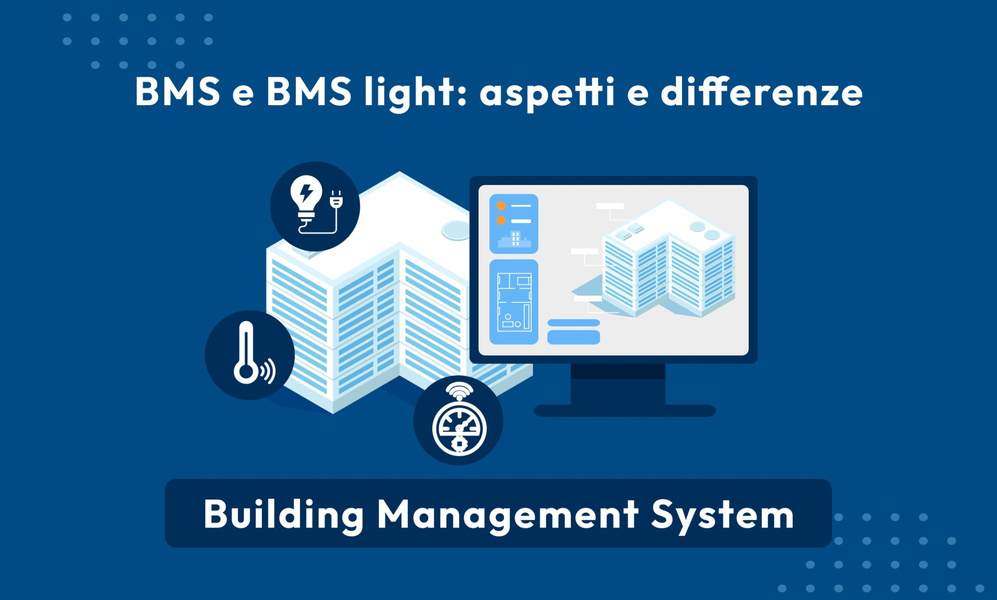
The Building Management System (BMS) is the centralized supervision system – composed of hardware and software – that controls and automates the technological systems of a building (lighting, air conditioning, security, fire protection), transforming it into a smart building.
The Main Advantages
- Energy Efficiency: Optimizes consumption by adjusting heating, cooling, and lights based on actual needs and occupancy schedules.
- Optimized Comfort: Maintains constant environmental parameters (temperature, humidity, and air quality) for the occupants of the spaces.
- Predictive Maintenance: Monitors system wear and tear and reports anomalies in real time, preventing sudden breakdowns.
- Integrated Security: Centralizes the management of alarms, video surveillance, access control, and fire protection systems, allowing timely interventions.
- Cost Reduction: Cutting energy waste and simplifying management operations translate into economic savings in the long term.
The Building Management System (BMS) light is a lean and centralized software and hardware solution for monitoring and automating systems (lights, climate, access). It offers the advantages of smart control while reducing installation costs, making it ideal for offices, shops, or medium-sized properties.
Unlike traditional systems, which require dedicated local servers, kilometers of specific wiring, and specialized software programmers, BMS Light leverages the advantages of modern technology:
- Cloud and IoT Architecture: The heart of the system often resides in the cloud. Data collected by sensors on the field are sent to remote servers, eliminating the need for expensive on-site IT infrastructures like the technologies of major global software houses, such as Siemens.
- Wireless Technologies: Many devices (temperature sensors, energy meters, light actuators) communicate via radio (using protocols like Wi-Fi, Zigbee, or LoRaWAN), drastically reducing installation costs and times compared to traditional masonry works.
- Plug-and-Play Interfaces: Configuration takes place through guided procedures and intuitive graphical interfaces, manageable directly from apps for smartphones, tablets, or web browsers.
- AI Algorithms: Using logic and algorithms based on AI, data are efficiently controlled remotely.
The main advantages of a Light version BMS include:
- Energy saving: Automatic adjustment of lights and temperatures through presence sensors, avoiding waste when rooms are empty.
- Centralized management: Compared to the main BMS management software on the market, such as Siemens, in a BMS light the control of all devices is obtained from a single intuitive interface, remotely, in clouds accessible also via smartphone or tablet.
- Preventive maintenance: Real-time monitoring of consumption and immediate notification of anomalies or faults, reducing downtime.
- Comfort and security: Optimization of the internal microclimate and the possibility to manage access remotely.
- Reduced investment: Compared to a traditional BMS, the light version has lower wiring and implementation costs, as well as faster installation times.
- Scalability: It is possible to start by monitoring only the heating system of a single area and later add, piece by piece, light control or water meters.


Informative Material